Guide
What is an air bike?
Published
Note: This page contains affiliate links. If you buy through them we may earn a commission at no extra cost to you. Learn more
In short
An air bike is a stationary bike with a large fan in place of a flywheel and handlebars that push and pull in time with the pedals. The fan creates the resistance: the faster you pedal and push, the harder it gets. There is usually no resistance dial. Air bikes are loud because the fan moves a lot of air, and they blow that air back at the rider.
Products for this job
Compare all 7 productsYesoul G1M Plus: 21.5 inch screen, self-powered
Check price on AmazonAffiliate linkVirtuFit Stage 2.0i: 22 kg flywheel, 24 levels
Check price on AmazonAffiliate linkBH SB Mag: magnetic, 20 kg flywheel, poly-V belt
Check price on AmazonAffiliate link
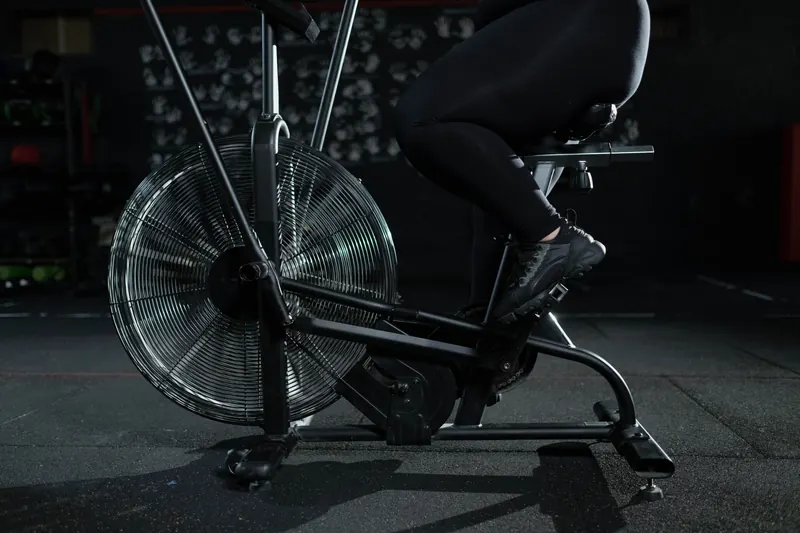
Air bikes are the big fan bikes you see lined up in functional training gyms and CrossFit boxes. They look nothing like a spin bike, and they behave differently too. This guide explains how fan resistance works, why the handles move, why these bikes are so noisy, how much room one takes at home, and how an air bike differs from a BikeErg, which also uses a fan but is built to feel like a road bike.
How fan resistance works
Instead of a heavy flywheel slowed by magnets or a felt pad, an air bike has a fan wheel with blades, usually at the front of the frame and often behind a mesh guard. When you pedal, the fan spins and pushes against the air. Air pushes back harder the faster the blades move, so the resistance rises steeply with your speed.
In practice this means there is nothing to adjust. Pedal gently and the bike feels light. Pedal hard and it feels heavy. The bike sets the resistance from your own effort, which is why air bikes have become a common choice for short, hard intervals in gyms.
Most air bikes have a simple console that shows time, distance, revolutions per minute and an estimate of watts. The watts figure comes from fan speed, because the relationship between fan speed and power is fairly predictable for a given fan design. Treat it as a guide for comparing rides on the same bike, not as a lab measurement.
Why the handles move
The handlebars on most air bikes are long levers linked to the crank. As your right leg pushes down, your right arm pushes forward, and so on, a bit like a cross trainer. You can push and pull on the handles to add to the effort that turns the fan, or rest your hands lightly and let your legs do the work.
Most models also have fixed grips or a central post so you can ride legs only, and foot pegs on the front fork so you can rest your feet and pump with your arms only. Seat height and fore-aft position adjust, but the handles themselves usually do not, so check the listed user height range before you buy.
- Moving handles linked to the pedals
- Fixed grips for legs-only riding on most models
- Foot pegs for arms-only work on many models
- Fan guard at the front, sometimes with a wind deflector
- Basic console with time, rpm, distance and estimated watts
Why air bikes are loud
Air bikes are among the noisiest home exercise machines. The fan makes a rushing sound that rises with speed, and at full effort it can drown out a television. There is no way to make a fan quiet while it is moving a lot of air, so the noise is part of the design rather than a fault.
The fan also blows air straight at the rider. Some people like the breeze. If you do not, many makers sell a wind screen or deflector that clips over the fan. In a flat, think about the people next door and below. A thick mat under the bike helps with vibration through the floor, but it does nothing for the sound of the fan itself. Our mats guide explains what a mat can and cannot do.
If a quiet bike matters more than the self-setting resistance, a magnetic spin bike is the better choice for most homes.
Air bike vs BikeErg vs spin bike
A BikeErg is Concept2's indoor bike. Like an air bike it uses a fan flywheel, but it has fixed handlebars, a road-bike style riding position and a damper on the fan housing that changes how much air reaches the fan, which alters the feel. It uses the same style of monitor as Concept2 rowers and is designed to feel more like riding a road bike. For details of current models and settings, check Concept2's own website and manual.
A spin bike uses a heavy flywheel with magnetic or friction resistance that you set with a knob, so the effort stays where you put it. That suits instructor-led classes where you are told to add resistance. Read air bike vs spin bike for a fuller comparison.
| Feature | Air bike | BikeErg | Spin bike |
|---|---|---|---|
| Resistance | Fan, rises with speed | Fan with damper | Magnets or felt pad, set by knob |
| Handles | Move with pedals | Fixed, road style | Fixed |
| Noise | Loud | Moderate to loud | Quiet if magnetic |
| Standing to pedal | Possible but uncommon | Yes | Yes |
| Typical use | Short intervals, gym circuits | Road-style riding indoors | Classes and app rides |
Space, set-up and care at home
Air bikes are heavy and long because of the fan, the moving arms and the wide base. Leave clear room at both sides so the handles do not hit walls or furniture as they swing, and room in front so the fan can draw and push air. Most have transport wheels on the front.
Maintenance is mostly simple. Keep the fan guard free of dust, check bolts on the handles and pedals now and then, and look at the chain or belt tension as described in the manual. Some air bikes use a chain, which needs occasional cleaning and light lubrication.
Our exercise bike dimensions guide explains how to plan floor space for any bike, and the spin bikes section covers set-up and noise in more detail.
Note:Air bikes are heavy. Move one with two people and keep fingers, children and pets well away from the moving handles and the fan while anyone is riding.
Frequently asked questions
Is an air bike good for a home gym? It suits a home gym if you want hard, short efforts with no settings to fiddle with and you can live with the noise. If you share walls, ride while others sleep, or prefer classes with resistance cues, a magnetic spin bike is easier to live with.
Can I buy an air bike in the UK? Yes. Several exercise equipment brands sell air bikes in the UK, both gym models and lighter home versions. Compare the listed user weight, fan size, seat adjustment and footprint, and check the maker's spare parts support.
Why do gyms have air bikes? They need no adjustment between users, they suit circuit and interval classes, and they are simple machines with few electronic parts. That makes them practical for busy gym floors.
Is an air bike the same as a BikeErg? No. Both use a fan, but a BikeErg has fixed handlebars, a damper and a road-bike riding position, while an air bike has moving handles and a more upright position.
What you need
- Check price on AmazonAffiliate link
Yesoul G1M Plus: 21.5 inch HD screen, live classes
From: Best spin bikes for home
- Check price on AmazonAffiliate link
Sunny upright bike: 4-way seat, free SunnyFit app